


Robotics
2025-26
HURRICANE HIGH ROBOTICS
CLUB PROMOTES STEM
INDUSTRY AT CITY
COUNCIL MEETING
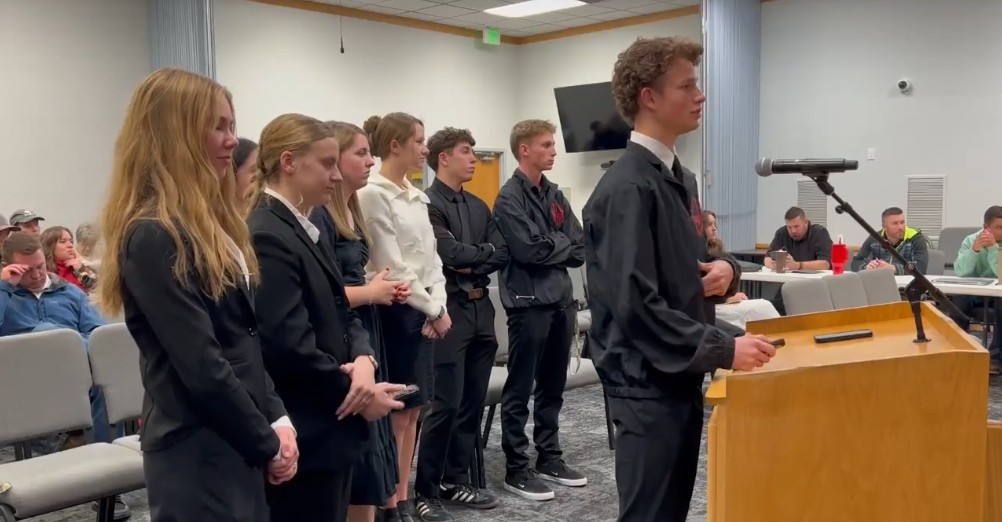
A group of teenagers from the Hurricane High School Robotics Club appeared before the Hurricane City Council on a snowy Thursday evening, not to present a robot, but to present themselves as residents with a love for engineering.
The Hurricane High School Robotics Club arrived at the Hurricane City Offices with two main goals in mind: establish a committee to help grow the science, technology, engineering and math-related jobs within the area, and to secure funding for the club.
Kaylani Ober, a member of the robotics club, pitched the value of their club to Mayor Clark Fawcett and the City Council.Â
“The (club) doesn’t just build robots; it builds people,” Ober said. “When you invest in us, you’re not just funding a season of our competition, you are investing in a project, and there’s always an expected return on that investment. By choosing to support our team, you are not just making a dead-end donation, you are choosing to create opportunities for young people that will pay dividends for this community for generations to come.”
Members of the robotics club said there is a need for more STEM-related jobs and opportunities in Hurricane. To pursue a STEM-related career after high school, they’ll have to leave their homes to find a place where their talents are in demand. The members explained that, as of right now, that place isn’t Hurricane.
To help grow the STEM industry in Hurricane, the robotics club members pitched the idea of a committee to support those interested in STEM.
Jayden Madsen, the captain of the robotics club and a senior at Hurricane High School, spoke with St. George News about the proposed committee.
“I think the next step is putting together that committee that we talked about,” Madsen said. “We talked about getting someone from each council member and coming up with those ideas of programs that we can make, and just talking to them, having meetings, and putting them into action, and then also finding the budget for it. A lot of (Hurricane High School’s) budget is going to things like sports and dance, and that’s great, but not many people are going to make money in the future over that. So if we can put more of that budget into STEM, then that’s the next step.”
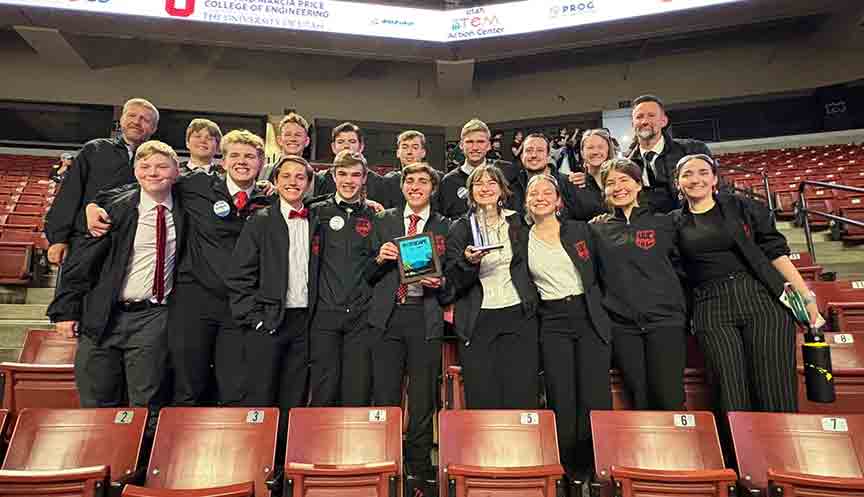
Madsen said the robotics club is the only Southern Utah team to compete in the FIRST Robotics Competition every year, attending events across the United States. The club won the Engineering Inspiration award at the Utah qualifier and traveled to Houston for the world championships.
To fund more of these endeavors, the robotics club said it’s trying to raise about $60,000 to move forward. Fawcett said the city’s budget had already been decided, but Hurricane City Manager Kaden C. DeMille interrupted, saying the city had a little money left for this kind of request.
That amount, which DeMille said they were willing to donate to the robotics club, was $772. The city is working on the next budget, and DeMille proposed allocating funds for the robotics club; however, the funds wouldn’t be available until July
Fawcett said he was impressed by the robotics club’s dedication, wished more youth would get involved with the City Council and was open to the idea of a STEM committee.
“I do really appreciate the fact that you’re willing to do this, and I don’t have any problem with doing the STEM committee,” he said.
Fawcett said two of his children had to leave the city to find employment, and expressed a desire for more STEM-related jobs in the city.
While he couldn’t offer an immediate solution, Fawcett said there is a growing industry in St. George.
Written by Stockton Myers
Feb 22, 2026 Updated 21 hrs. ago
2024-25
2023-24
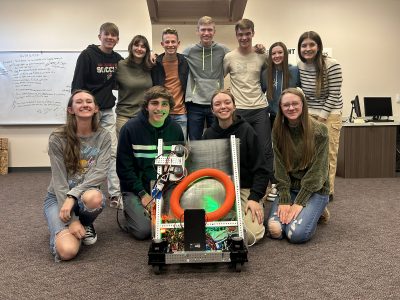
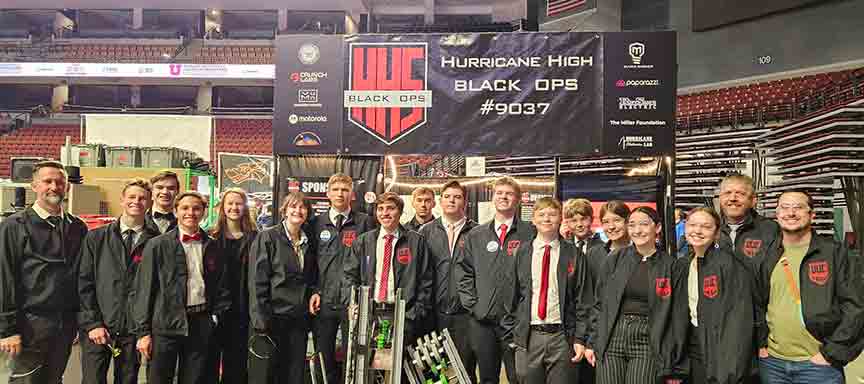
HURRICANE — Hurricane High School is part of the The First Innovation In Recognition of STEM Science and Technology and the home of team Black Ops, a group of 20 students that design, build, program, drive and market their robot.
But this team has a leg up on the competition. They recently visited Crunch Labs, the brainchild of 30-million-subscriber YouTube sensation Mark Rober, for three days.
“He’s like the modern day Bill Nye,” David Vick, the faculty member of the program, told St. George News.
Rober helped them with their learning process. The students said this gives them an advantage over competitors.

“The robot really didn’t look like anything at all, we kind of just had this base. he kind of helped us with our process,” said David Henderson, one of the captains of Black Ops.
What makes this robotics program unique is that success isn’t measured by championships or trophies.
“We measure success based on the skills that each one of our kids possess,” Vick said.
Each member is required to become familiar with every part of the process and be able to handle each software required to create the robot. Students also learn ho
w to use AutoCAD, a design software, Python, a coding language, and Adobe Illustrator, an art software.
BlackOps participants are not enrolled in a club or after school program where anyone can sign up. Instead, these students are hand picked by academic merit. The program has grown its membership, but still doesn’t have as many students as other teams they have encountered.
In the past, the program competed in both the FIRST Technical Challenge and FIRST Robotics Competitions, while this year focusing primarily on FRC. While FTC involves smaller robots with an 18 by 18-inch cube, FRC features larger robots with a prototype size up to 30 by 30 inches.
Funding for the program, with an annual registration cost of $6,000, primarily comes from community contributions and fundraisers. The program has previously received grants, including one from the Department of Defense.
They’re in week two of their six-week allocated time to build their robot. They’re looking forward to improving on their prototype and to be ready for the competition in late February.
“We don’t use kids to build robots; we use robots to build kids,” Vick said.